Pages

Monday, December 3, 2018

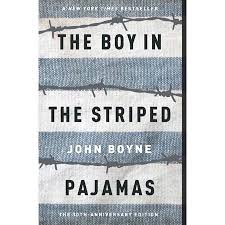
The Boy in the Striped Pajamas


The Boy in the Striped Pajamas
By John Boyne
Image result for striped pajamas


This novel is about a young boy named Bruno. His father is a Nazi commandant, but he doesn't know it. He is only 9. His family moves near a concentration camp and he only knows what his father tells him - which isn't much. Bruno is told not to leave the house, but he loves to experience new adventures so he explores. He finds the camp and makes a friend. He has so many questions. He doesn't understand the reason behind why everyone is wearing pajamas. He doesn't know why the people are behind a fence. He thinks maybe they are farmer. He isn't sure. This book allows young readers to connect with an extremely dark part of history in a very different way - through the eyes of a child.

Pre/Post Activities: 

Choice Board for Novel - Lots of ways to show
Compare and Contrast: How did the movie “The Boy in the Striped Pajamas” differ from the book you read?
Answer the connection questions at the bottom of the link after you read this document: Take this Giant Leap
A Basic Feeling of Human Dignity - Answer the Connection Questions at the bottom of the link after reading this document
Watch this video of the step-by-step Phases of the Holocaust - summarize each step - this Handout will help

Friday, September 7, 2018

Nothing But the Truth

Nothing But the Truth by Avi


Phillip Malloy is in high school. He loves sports and isn't too fond of his English teacher. He gets into trouble, but doesn't feel he did anything wrong and won't apologize. There is a lot more to this documentary novel and I would recommend it to anyone with reluctant readers in their classrooms. You will want to find out what happens to Phillip, his English teacher and how the truth can be blown out of epic proportions.

Pre/Post Nothing But the Truth Activities: 

Tuesday, October 10, 2017

Having Our Say


This memoir tells the story of two sisters who both lived to be over 100 years old. There is so much history to unpack in this book. Sadie and Bessie were the children of slaves and grew to become professionals living in Harlem, New York. One became a teacher and one became a dentist. This is a perfect book to help students learn about and explore their own history within their own families.

Pre/Post Activities for Having Our Say

Wednesday, November 9, 2016

Flowers for Algernon

Amy's review of Flowers for Algernon

This book is written in journal form, which makes it easy for readers to follow. Charlie Gordon is a young adult with a disability. He can't read or write like everyone else, but he certainly gives his best effort. He signs up and is selected to undergo brain surgery. This brain surgery changes his life and for a short while, he is smart - so smart, his doctors that operated on him don't even understand the concepts that he does. Charlie's decline is inevitable. Even Charlie knows it will happen. Read the book to find out more about his struggles. Great book - with excellent Science and cross-curricular connections. 

Pre/Post Activities for Flowers for Algernon: 

Saturday, August 31, 2013

Warrior Princess


Beck, K., Speckhard, A., & Shepherd, W. (2013). Warrior princess: a U.S. Navy Seal’s journey to coming out transgender.  McLean VA: Advances Press.

Hardback | $24.99 USD | ISBN-13: 978-1935866435 | 254 pages | Adult Non-Fiction 


What is gender? Is it only the physical parts that we are born with?  If our gender changes will society accept these changes readily? Can gender be constructed inside your mind or heart or brain?  Many in our society have their own opinion on this and these opinions differ so widely. Kristen Beck will share her opinion and life story as she transitioned from a man to a woman in her co-authored memoir Warrior Princess.  

Kristen Beck was once called another name: Chris Beck.  Chris was a high school football player, drove a motorcycle and became a U.S. Navy SEAL. He was in the military for over twenty years. He earned a Purple Heart and a Bronze Star (“Barnes and Noble,” n.d.). He was a man physically, but, he knew at a young age that he was meant to be a woman.  His family was religiously conservative so he didn’t say anything – he had no one to share this with. He withdrew and lived with these feelings internally for a long time. Then, he retired from the military and went through the stages to change his gender completely.  Chris became Kristen and this is her story.

Of course, it was not an easy journey for Kristen – she had to deal with her family’s rejection, failed relationships, and PTSD from serving on thirteen deployments, including seven combat deployments. But, she wanted to share it. Kristen’s story will help all of us to see that it is more important to be who you are and express that freely than hide your true identity.  Her story may help us all to empathize with others experiencing the gender identity issues that our culture judges so intently and so viciously.  Perhaps more coming out stories like this one will combat our society’s strict rules and perceptions of what gender can be in our society.

Beck worked with Anne Speckhard, Ph.D., an Adjunct Associate Professor of Psychiatry at Georgetown University Medical School to write this memoir.  Dr. Speckhard has been working in the field of PTSD since the 1980s (“Anne Speckhard”, n.d.).  Though the book may have needed one more team member to provide more concise editing, this book is recommended for young adult readers (ages 18+) who may be struggling with coming out as a transgender. Also recommended for other readers who want to understand the journey and very difficult path for those among us who struggle with gender identity, perhaps in our own families. U.S. Navy SEALS are the manliest of men – they are warriors. Only men are permitted to be U.S. Navy SEALS. Perhaps this story will show you that it is not the gender of the person that determines who they are, but their actions and service.  Beck worked diligently and served our country well during his tenure in the Navy.  Maybe because Beck was so tough and trained to be strong, she was able to share her story and her struggle.  If she can do this, than anyone can. 

Americanah


Adichie, C. N. (2013). Americanah. New York: Knopf.

Hardcover | $26.95 USD | ISBN-13: 978-0307271082 | 496 pages | Adult Fiction 

Americanah

Adichie has written a chilling masterpiece.  This novel can’t be about just one topic because so much is woven together. Here are some of the questions addressed: What does it mean to be African and live in America?  How does moving from Nigeria to America affect and change someone?  What is the impact this will have on relationships? On love?  What will be realized about communities? White privilege? What will be learned about ethnocentrism and about our own identities? These are all questions that Adichie discusses through her character Ifemelu, a young Nigerian woman who moves to America in pursuit of a higher education. 

Ifemelu has moved to America to study and to become a wrier. She has her ideas about what America should be like based on TV shows like the Cosby’s, but upon her arrival she realizes its not what she thought. She is there to attend school and starts off fresh and new and is learning a lot about her new homeland called America. Truth is, the experience of coming to America, taught her a lot and taught her about things she did not know existed, including the four letter word: race. The concept of race didn’t exist in Nigeria, but it exists on every street corner, store, and train station in every city in America. She learns what it means and what it feels like to be “black” in America. Ifemelu begins to write a blog about race in America.  She does not have it easy in America – she hits some real lows and struggles to find a job, but through a lot of flashbacks we learn that she does gain an education, a fellowship at Princeton and finds a new love in an African American professor.  Her life was kind of easy in comparison back in Nigeria, or maybe it was just simpler. Ifemula ends the blog and returns to Nigeria after thirteen years of living in cities all around the U.S. But she isn’t returning to what she originally planned. Things have changed.

To make the story more interesting, there are parallel stories intertwined. Her teenage love, Obinze, wanted to also come to America to finish school, but because it is post 9/11 he is not permitted to enter the U.S. Instead he goes to London and faces his own challenges with finding a job. He tries to fake a marriage but is deported. He struggles just as much as Ifemelu, but upon his return to Nigeria he marries again, but the problem is it wasn’t for love and he is not happy. Adichie’s characters are both unhappy and unsatisfied with the position that they found themselves in, although oceans and continents apart. Their love went in opposite directions while their hearts remained in Nigeria, though they didn’t know it. It took a journey of self-realization to appreciate the life they had. However, the experiences taught them and stretched them.

This realistic love story will provide readers with plenty of insight for those who want to have their eyes opened to the issues of race, migration and struggles in America. This book is highly recommended for all readers. Though race has an important role in this book, not only Africans or African Americans need to read this. This is one book that all readers from all races should read because the honesty of the characters and their experiences will teach us all. It belongs in every library’s multicultural collection. This work is highly recommended for all public libraries.
Friday, August 30, 2013

Eminent Outlaws


Bram, C. (2012). Eminent outlaws: The gay writers who changed America. New York: Twelve.

Hardcover | $27.99 USD | ISBN-13:  978-0446563130 | 372 pages | Adult Non-Fiction


Eminent Outlaws is a history lesson on the gay literary authors who wrote in the time period of the 50s through the 90s and after.  While reading Bram’s historical narrative, you can understand the major writers who approached gay literature differently but collectively were able to impact writing and works that were published in general in America and beyond.

Bram explains the different cultural and historical events and their relationship and impact on attitudes and ideas shared by the gay writers of this time. There is a lot of variation in how the writers approached their literary works and it was definitely impacted by the time period in which the authors wrote and lived. Some wrote about openly gay characters and lived an openly gay lifestyle while others wrote plays that only hinted or mentioned the idea of homosexuality and lived their lives behind closed doors.

The way in which homosexuality was explored in literature was impacted by how the gay movement itself developed.  In the 50s “homosexuality was not completely forbidden, but it was in a tight spot” (Bram, 2012, p. 20). Still, it seems that didn’t change because fifty years later, admirers downplay the “Gayness” of poetry and the author Ginsberg (p. 37). Bram shares that during the 50s, many writers were silent on homosexuality, but it was so “despised in some circles” it was seen as a threat (p. 69).  Although this changed in the 60s when readers wanted to see relationships for what they really were (p. 79) and when viewers wanted to watch gay figures shine on late night talk shows (p. 89).  Riots in the late 60s caused a few problems, but this raised publicity of the movement when gay bars were regularly raided and gays were arrested (p. 134-135). Many were not sure which direction to go to best fight for gay rights – this led to many arguments and schisms for how to move forward (p. 136).  Gay liberation would follow in the 70s; but it wasn’t unordinary for gay literature to be published after the authors died to protect their reputations (p. 151). The biggest shift came in the 70s when gays in larger numbers finally gave themselves a name and they told their families about their preferences too (p. 194).

Christopher Bram combines all of the authors from this time period in one book for any readers who are interested in the development of gay authors and its impact on America’s 20th century.  The book itself is laid out in a readable format and the chronological procession makes it easy to follow along with the development of the time. I would recommend this book for adult readers, gay or straight, and public libraries with diverse populations.  This book would fit well in a library’s collection on social history and gay literature. Any readers who can appreciate a cultural history book interwoven with personal stories about the author’s lives will appreciate this novel.